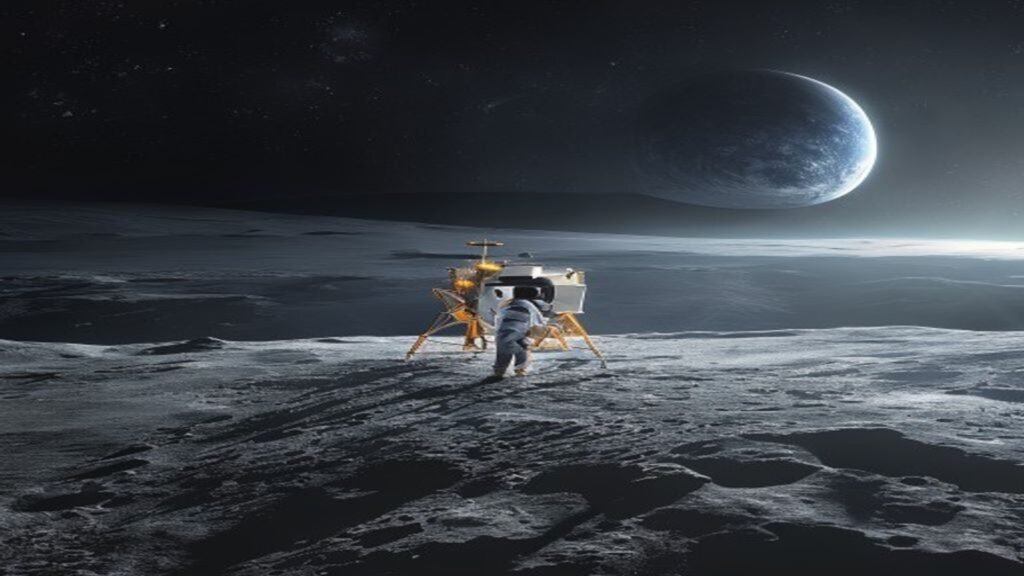
Half a century after the last Apollo boot print, humanity is going back to the Moon — but not to the equatorial plains the astronauts of the 1960s knew. The destination this time is the lunar south pole, a landscape of eternal shadows and near-perpetual sunlight where the strategic resources of the next space age are concentrated. And unlike the two-superpower sprint of the Cold War, today’s race is crowded.
Why the South Pole Matters
Two features make the region priceless. First, water ice: permanently shadowed craters, untouched by sunlight for billions of years, hold frozen water that future missions could drink, breathe (split into oxygen), and burn (converted to hydrogen rocket fuel). Water launched from Earth costs enormous sums per kilogram; water mined on-site rewrites the economics of deep-space exploration. Second, power: certain crater rims near the pole receive sunlight for the vast majority of the year, offering near-continuous solar energy — the closest thing to prime real estate anywhere off Earth. The usable spots are few, small, and cannot be shared indefinitely, which is precisely what makes the competition sharp.
The Contenders
The United States anchors its return on the Artemis program — a coalition effort with dozens of signatory nations under the Artemis Accords — pairing NASA’s crewed ambitions with a fleet of commercial landers that have already begun delivering instruments to the lunar surface, with mixed but improving results. China, working with international partners on its planned research station, has executed a methodical campaign of robotic successes, including historic far-side sample returns, and has publicly targeted crewed landings before decade’s end. India joined the south-pole club with its landmark Chandrayaan touchdown, becoming the first nation to land in the region and cementing its status as a serious spacefaring power on a famously lean budget. Japan, Europe, and a growing roster of private companies fill out a field unimaginable a generation ago.
The Rules Problem
Governance has not kept pace with ambition. The Outer Space Treaty of 1967 bars national appropriation of celestial bodies but says little about resource extraction or how two programs share a crater rim. The U.S.-led Artemis Accords endorse “safety zones” around operations; China and Russia sit outside that framework, building a parallel coalition. Space lawyers debate whether mining lunar ice constitutes appropriation; diplomats quietly game out what happens when two nations want the same peak of eternal light. The likeliest near-term outcome, analysts suggest, is precedent set by practice — whoever operates there first will define the norms everyone else argues about.
More Than Flags and Footprints
What distinguishes this race from Apollo is permanence. Every major program describes not visits but infrastructure: habitats, power grids, communications relays, and eventually fuel depots supplying missions deeper into the solar system. The Moon has become the proving ground for Mars ambitions and a prestige arena in an era of terrestrial rivalry — a place where technological credibility is demonstrated in the most public way possible.
The first woman and the next generation of explorers will likely make history near a crater whose floor has not seen sunlight in four billion years. The race to get there — measured in launches, landings, and legal maneuvering — is already the defining space story of this decade.